


Calculations and Tribulations

Updated: Jan 25
Another blog post, another redesign. This should be the final redesign. I have repicked my motor. I will use an Aerotech F2
7R-4 motor. The thrust curve aligns very well with my goal of hitting ½ a km.
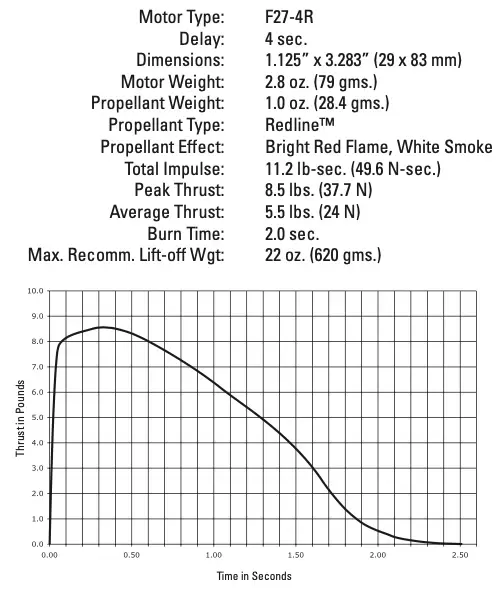

Calculations (for simplicity's sake, I will use 3 significant figures)
Total impulse $$J = 49.6 N \times s$$
Average thrust $$T_{avg} = 24.0 N$$
Peak thrust $$T_{pk} = 37.7 N$$
Burn time $$t_b = 2.00 sec$$
Propellant mass $$m_p = 1.0 oz = 0.028 kg$$
Gravity $$g = 9.80665 m/s^2$$
Rocket liftoff mass: $$m_0 = 18 oz \times 0.028 = 0.510 kg$$
Burnout mass: $$m_b = m_0 - m_p = 0.510 kg - 0.028 kg =0.482 kg$$
Average mass during burn:
$$m_{avg} = 12 (m_0 + m_b) = 12 (0.510 + 0.482) = 0.496091 kg$$
1) Thrust-to-weight
$$(T/W)_{avg} = \frac{T_{avg}}{m_0 \times g} = \frac{24.0 N}{0.510kg \times 9.81 m/s^2} = 4.80 N$$
$$(T/W)_{pk} = \frac{T_{pk}}{ m_0 \times g} = \frac{37.7 N}{0.510 kg \times 9.81 m/s^2} = 7.53 N$$
2) Burnout velocity
Downward Impulse due to gravity:
$$I_g=m_{avg} \times t \times v_b = 0.496091 \times 9.80665 \times 2=9.73 Ns$$
Net upward impulse from the motor after gravity:
$$I_{net} = J - I_g = 49.6 - 9.73 = 39.9 N \times s$$
Divide by the average mass to get the burnout speed:
$$v_b = I_{net} \times m_{avg} = 39.8 \times 0.496 = 80.4 m/s $$
Average net acceleration during burn:
$$A_{avg} = \frac{J \times t_b - m_{avg} \times g}{m_{avg}} =\frac{24.8-4.87}{0.496}=40.2 \frac {m}{s^2},$$
then $$v_b = a_{avg} t_b=40.184 \times 2 = 80.4 m/s$$
3) Altitude gained while under power
$$H_b = \frac{1}{2} \times a_{avg} \times (t_b)^2 = 12 \times 40.2 \times 2^2 = 80.4 m$$
4) Coast to apogee (gravity only, no drag)
$$h_c=\frac{(v_b)^2}{2g}=\frac{(80.368)^2}{2 \times 9.81} = 329 m$$
5) Ideal apogee and time to apogee
$$h_{max}= h_b + h_c = 80.4 + 329=410. m$$
$$t_{max} = t_b + \frac{v_b}{g} = 2.0+\frac{80.4}{9.81} = 10.2 s$$
So, assuming no drag on an 18-oz rocket, we will get a maximum apogee of 410.m. Based upon experience, drag usually cuts around 25% of most short-range flights so I can safely (but unscientifically) assume this rocket will hit about 300m.
Looking forward, I know the real grind is going to be in the CAD work. I’m very much a novice when it comes to design software, and while I’ve managed to piece together some simple assemblies, the kind of precise modeling I’ll need for this project is a whole different beast. It’s not that I can’t learn it, but it’s time-consuming in a way that I’ll really have to plan for. Every dimension has to line up, every surface has to be clean, and even small mistakes can mean starting over on a part.
Once I get the design nailed down, the next big challenge will be collecting the data. That means building a repeatable testing setup and making sure I can log all the right measurements: velocity, altitude, pressures, forces, you know, the works. I’ll need to run multiple trials, clean up the data, and then actually make sense of it. It’s not just about running the tests (which is a monumental challenge by itself), but making sure the results are solid enough that I can trust them. That part is exciting but also a bit daunting, since it’ll be my first time managing an experiment of this scale from start to finish.

Comments